When two custom canopies look identical in a photo, the difference that matters is usually hidden inside the legs. The frame decides how many seasons the tent survives, how it behaves in wind, and most of what you pay. The canopy fabric decides how it prints, how it sheds rain, and whether a venue will let you set it up indoors. This is a practical comparison of steel and aluminum frames, followed by how to read the fabric spec so you are not buying on a marketing number alone.
The frame is the real buying decision
Pop-up canopy frames come in two materials, and they are not close substitutes. Steel is dense, cheap, and stiff enough for occasional use, but it is usually powder-coated, and powder coat chips and scratches, which lets rust start. A typical steel economy frame uses roughly one-inch legs with about a one-millimeter wall. Aluminum is lower density per unit of material, so makers build the tubing thicker, often around two-inch legs with a two-millimeter wall, and finish it with an anodized layer that will not chip off or rust. The result is a frame that resists bending under repeated setups and takes more wind before it deforms; some commercial aluminum models are rated by their makers to around 35 to 40 mph with proper weights or stakes.
A quick word on weight, because it is often misunderstood. Aluminum is lighter than steel for the same amount of metal, but because commercial aluminum frames use thicker tubing, a heavy-duty aluminum frame is not automatically lighter than an economy steel one. The portability advantage shows up most in mid-grade frames; at the top of the range you are buying stiffness and longevity, not featherweight.
Where steel frames make sense
Steel earns its place when a canopy comes out a handful of times a year in fair weather. Think backyard parties, the occasional market, a beach day, or a booth you will use three or four times a season. The upfront cost is low, and if the tent lives in a garage between uses, the coating holds up reasonably well. The trade-offs are real, though: steel frames carry shorter warranties, they can bend if you fight them in gusty conditions, and heavy users often find themselves replacing a steel frame every year or two. If your calendar is light and your budget is tight, that math can still work.
Where aluminum frames earn their price
Aluminum is built for a schedule. If you set up weekly or monthly, travel between events, and cannot afford a no-show because a leg buckled, the anodized aluminum frame is the tool for the job. The stiffer tubing shrugs off the repeated open-and-close cycles that wear steel out, the finish does not rust when it gets rained on and packed away damp, and warranties commonly stretch to five or seven years, with some makers offering lifetime coverage on the frame. For a vendor whose booth is the storefront, the higher cost is spread across hundreds of setups rather than a handful.
What it costs
The price gap tracks the durability gap. A custom-printed 10×10 on a steel frame costs noticeably less than the same size on a commercial aluminum frame, and the spread between frame grades is wide, depending on frame grade, print coverage and accessories. The honest way to choose is to divide the price by the number of setups you realistically expect: a cheap steel tent used four times a year and replaced in two years costs more per use than it looks, while an aluminum tent used weekly for years costs remarkably little per event. For a written quote on either, send your size and artwork to Get Custom Tents.
Reading the canopy fabric spec
Denier is not a quality grade. It measures the thickness of the individual yarns, so a 600D fabric has thicker yarns than a 500D one, but that number alone does not tell you how strong, waterproof, or long-lived the canopy is. A well-engineered 500D with a tight weave and a good coating routinely outperforms a loosely woven 600D, which is part of why 600D is so often quoted as a marketing figure. Light-duty canopies use 150D to 300D; most commercial event tops sit around 600D; and permanent installations move to heavier vinyl in the 1000D-and-up range. Read the weave and the coating alongside the denier, not instead of it.
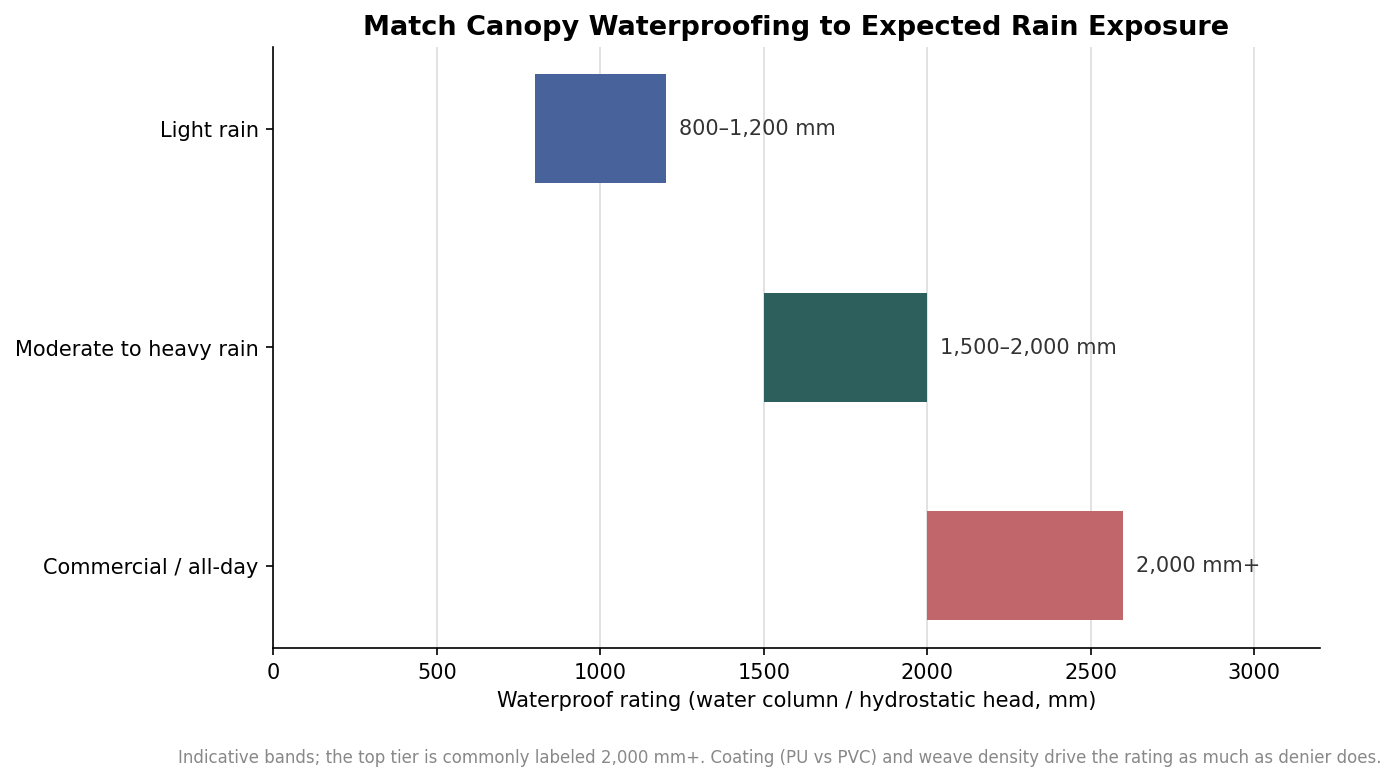
Waterproofing is measured as a water column, or hydrostatic head, in millimeters, and you should match it to the weather you actually expect. Roughly 800 to 1,200 mm handles light rain, 1,500 to 2,000 mm covers moderate to heavy rain, and 2,000 mm and up is commercial, all-day protection. A polyurethane coating is light and flexible for most event use, while a heavier PVC coating suits industrial and long-exposure setups. For sun, look for a fabric rated UPF 30+ or UPF 50+.
Two more things belong on your checklist. First, fire certification: public events, indoor venues, and many municipalities require a flame-retardancy certificate such as CPAI-84, NFPA 701, or ULC-S109 for the canopy top, so confirm the tent carries one and keep the paperwork with the tent. Second, print method: dye sublimation bonds the ink into the polyester fibers so the graphic will not crack, peel, or fade the way a surface print can, which is what you want on a top that lives outdoors. Pick the frame for your schedule, match the fabric to your weather and your venue rules, and the canopy will do its job for years rather than seasons.